
Altes Museum
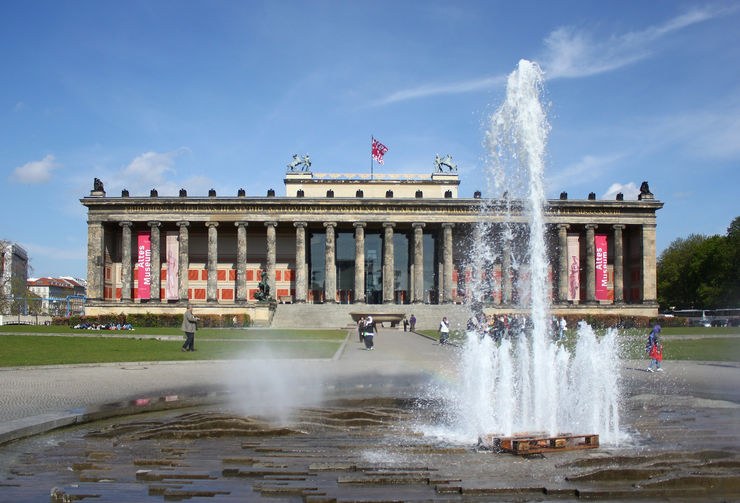
The Altes Museum ( Old Museum), located in Lustgarten on Museum Island is impressive for both incredible neoclassical architecture and its renowned collection of antiquities.
Designed by the renowned Prussian architect Karl Friedrich Schinkel, construction took place between 1823 and 1828. it was inaugurated as a museum in 1830.
The museum underwent a long period of repair and restoration between 1951 and 1966. Some of the repairs were to damage caused during the Second World War. In 1999 it was designated as a UNESCO World Heritage site. Further restorative work was undertaken between 2010 and 2011.
As you approach the entrance to the Altes Museum you will be greeted by a massive staircase leading up to the 18 towering columns of the Portico. This is reminiscient of the Parthenon in Athens, Greece. A sculpture of an eagle stands directly above each column on the front edge of the roof.
The staircase and elevated main floor, are not just for grandeur, they were neccesary to protect the museum from occassional floods.
Upon entering, you’ll find yourself in an large, impressive, light-filled rotunda ringed with antique sculptures. From there you’ll be led on a chronological journey through two floors of rooms containing ancient Roman, Greek and Estrucan artifacts. Highlights include a huge collection consisting of 1300 coins dating from the 7th Century BC to the 3rd Century AD, the treasure chest, a valuable collection of ancient jewelry and gemstones, and busts of Caesar and Cleopatra.
Allow about one-and-a-half to two hours for your visit.
Facts For Your Visit
Fee: YesAltes Museum Hours:
Opening hours may differ on holidays
- Monday: Closed
- Tuesday: 10:00 AM – 5:00 PM
- Wednesday: 10:00 AM – 5:00 PM
- Thursday: 10:00 AM – 5:00 PM
- Friday: 10:00 AM – 5:00 PM
- Saturday: 10:00 AM – 6:00 PM
- Sunday: 10:00 AM – 6:00 PM
Address: Bodestraße 1-3, 10178 Berlin, Germany
Phone: 030 266424242
Official Website: Altes Museum
Altes Museum Reviews
Rated out of 5
 This is not just a museum, but a home to the Berlin Goddess, a testament to the city's rich cultural heritage. The museum's collection is a treasure trove of ancient European artifacts, showcasing the region's history, art, and culture in exquisite detail. The first thing that caught my attention was the impressive collection of sculptures on display. The level of craftsmanship and artistry that has gone into creating these masterpieces is truly awe-inspiring. The sculptures are not only beautiful but also demonstrate a profound understanding of human anatomy, which is a testament to the advanced knowledge of the ancient world. The attention to detail and the precision with which the sculptures have been crafted are a wonder to behold.
The pottery collection, in particular, is noteworthy, with pieces that are remarkably well-preserved and showcase the ingenuity and creativity of ancient craftsmen. The shapes, designs, and patterns that adorn these pottery pieces are a window into the past, offering a glimpse into the daily lives and traditions of ancient civilizations.
What impresses me most about the Altes Museum is the way it seamlessly weaves together the threads of history, culture, and art to create a rich tapestry that is both informative and engaging. The museum's curators have done an outstanding job of selecting and presenting the artifacts in a way that is both accessible and meaningful to visitors of all ages and backgrounds.
Throughout my visit, I was struck by the sense of wonder and curiosity that the museum inspires. The Berlin Goddess, which is the centerpiece of the museum, is a powerful symbol of the city's cultural heritage, and the artifacts that surround her are a testament to the enduring legacy of ancient European culture.
This is not just a museum, but a home to the Berlin Goddess, a testament to the city's rich cultural heritage. The museum's collection is a treasure trove of ancient European artifacts, showcasing the region's history, art, and culture in exquisite detail. The first thing that caught my attention was the impressive collection of sculptures on display. The level of craftsmanship and artistry that has gone into creating these masterpieces is truly awe-inspiring. The sculptures are not only beautiful but also demonstrate a profound understanding of human anatomy, which is a testament to the advanced knowledge of the ancient world. The attention to detail and the precision with which the sculptures have been crafted are a wonder to behold.
The pottery collection, in particular, is noteworthy, with pieces that are remarkably well-preserved and showcase the ingenuity and creativity of ancient craftsmen. The shapes, designs, and patterns that adorn these pottery pieces are a window into the past, offering a glimpse into the daily lives and traditions of ancient civilizations.
What impresses me most about the Altes Museum is the way it seamlessly weaves together the threads of history, culture, and art to create a rich tapestry that is both informative and engaging. The museum's curators have done an outstanding job of selecting and presenting the artifacts in a way that is both accessible and meaningful to visitors of all ages and backgrounds.
Throughout my visit, I was struck by the sense of wonder and curiosity that the museum inspires. The Berlin Goddess, which is the centerpiece of the museum, is a powerful symbol of the city's cultural heritage, and the artifacts that surround her are a testament to the enduring legacy of ancient European culture.
faozan rizal. ICS - 8 months ago
Walking into the Altes Museum felt like stepping back in time. The grand row of columns and the impressive architecture immediately caught my attention, giving the entire place a sense of elegance and history. Inside, I spent hours exploring the fascinating collection of ancient Greek and Roman artifacts, from beautifully preserved sculptures to intricate pottery and jewelry. The rotunda at the center of the museum was especially stunning, creating a peaceful atmosphere that made me pause and admire the design. What I enjoyed most was how the exhibits brought ancient civilizations to life, making history feel tangible rather than distant. Whether you're interested in archaeology, art, or simply beautiful architecture, the Altes Museum offers a memorable experience and is definitely one of the highlights of Berlin's Museum Island.
Agrim Karki - 2 months ago
One of the most impressive buildings I’ve ever walked up to.
The Altes Museum sits at the edge of Lustgarten like it was built to stop you in your tracks and it does. Eighteen Ionic columns stretching the full width of the facade, Latin inscriptions in gold, bronze equestrian sculptures flanking the entrance steps. On a clear winter day with the sun hitting the stone just right, it looks almost unreal.
Inside, the neoclassical rotunda greets you immediately a circular domed hall modeled after the Pantheon in Rome, with mosaic floors and ancient Roman and Greek sculptures arranged around the perimeter. There’s an old gentleman I noticed sketching one of the marble statues, which felt exactly right for a place like this.
The collection itself takes you through Greek and Roman antiquity gods, emperors, busts, vessels, everyday objects that somehow survived two thousand years. The rooms are intimate and well-lit, with a deep red background that makes the white marble really sing.
But even if you don’t go inside, stand in Lustgarten and look at it for a while. There was a street musician playing keyboard on the cobblestones out front, the Spree nearby, and that building behind everything built in 1830 and still completely unbothered by time.
Worth every minute.
Daren Ng - 3 months ago
My recent trip to the Altes Museum on Berlin's Museum Island was a journey through time and architectural brilliance. Built between 1825 and 1830 by Karl Friedrich Schinkel, this UNESCO World Heritage site stands as a masterpiece of German Neoclassical architecture, with its 18 imposing Ionic columns facing the serene Lustgarten.
Stepping inside, the breathtaking central rotunda—modeled after Rome's Pantheon—immediately captivated me. Natural light streams through the oculus, illuminating classical statues arranged in perfect symmetry. The museum houses exceptional collections of Greek, Etruscan, and Roman antiquities, from intricate vases and golden jewelry to lifelike marble sculptures.
What struck me most was the museum's peaceful, scholarly atmosphere. Unlike busier museums, it allows for quiet contemplation of ancient artworks. The building itself is as much a treasure as its collections, embodying the 19th-century ideal of making art accessible to all citizens. A visit here offers not just a glimpse into ancient civilizations, but also a profound appreciation for Schinkel's visionary design.
Jonathan - 4 months ago
A visit to the Altes Museum is as much about the building as the objects inside. Located on Berlin’s Museum Island, the museum is one of the finest examples of Neoclassical architecture, designed by Karl Friedrich Schinkel and opened in 1830 as one of the first public museums in Prussia.
The exterior is eye catching, a monumental staircase and a long row of 18 Ionic columns facing the Lustgarten give the building the feel of a classical Greek temple dedicated to art. Inside, the impressive rotunda creates a grand, almost ceremonial atmosphere.
The museum houses the Collection of Classical Antiquities, focusing on Greek, Etruscan, and Roman art. Highlights include ancient sculptures, decorated vases, jewelry, and coins, along with famous portraits of Julius Caesar and Cleopatra and one of the largest collections of Etruscan artifacts outside Italy.
The Altes Museum is elegant, historically important, and beautifully designed. Even if ancient artifacts are not your main interest, the architecture alone makes it worth stepping inside—classic Prussian ambition in stone. If you’re exploring Museum Island, it’s a solid starting point before moving on to the bigger heavyweights nearby.
A must visit in Berlin with the rest of museums in the island.
Sam - 6 months ago

Directions
How to get to Altes Museum by U-Bahn, S-Bahn
Nearest U-Bahn, S-Bahn Line(s): S1, S2, S3, S5, S7, S9, S25, S26, S75, U6
Nearest U-Bahn, S-Bahn Station(s): Berlin Friedrichstraße
Exit from Friedrichstraße Station. Walk one block south on Fredrichstrasse and go left (east) on Dorotheenstrasse. When you get to the river, go right on Am Kupfergraben and cross the bridge just ahead. Once over the bridge turn right into Lustgarten to get to the front of the Altes Museum.
Map & Instant Route Finder
Click&Go Map and Route Finder with public transit, walking, driving or cycling directions. Get up-to-the-minute transit times for your route.
Accommodations near Altes Museum:
Photo Gallery
-

Photo Credit: Harald Groven - cc license via Flickr -

Photo Credit: abbilder - cc license via Flickr -

Photo Credit: dalbera - cc license via Flickr -

Photo Credit: abbilder - cc license via Flickr -
Photo Credit: abbilder - cc license via Flickr -

Photo Credit: xiquinhosilva - cc license via Flickr -

Photo Credit: xiquinhosilva - cc license via Flickr -

Photo Credit: xiquinhosilva - cc license via Flickr -

Photo Credit: xiquinhosilva - cc license via Flickr
