
Bode Museum
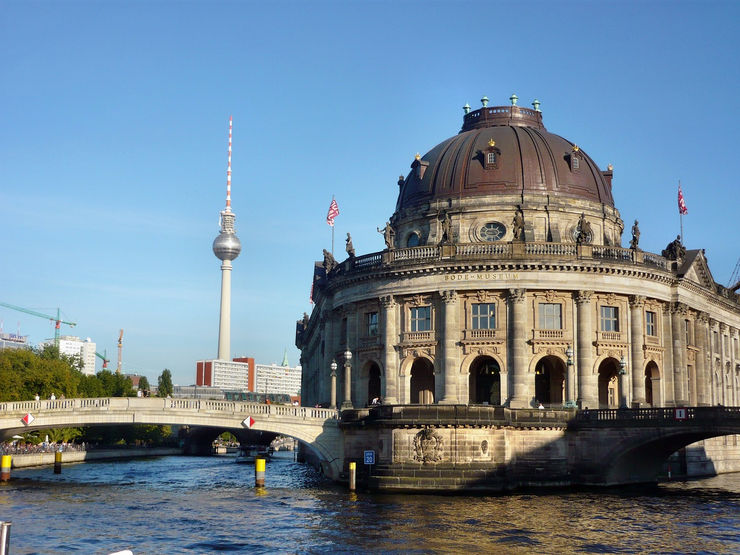
On the North end of Museum Island the Majestic Dome and the Neo Renaissance Baroque architecture of the Bode Museum will seize your attention.
You reach the museum by walking across the beautiful stone Monbijou Bridge.
Inside, you will enjoy exploring 61 Halls of exhibits dating from the Middle Ages to the 18th century. Allow enough time to explore the Sculpture Gallery, the Museum of Byzantine art, and The Numismatic Collection.
The sculpture collection is comprehensive and includes such renowned works as Passive Madonna, a marble sculpture from 1420, the Virgin Child made from glazed terracotta in 1450, and the Neoclassical Dancer from 1812.
You will be carried back in time as you ponder over 150 paintings dating from the Third to the 15th century AD.
One of the most popular exhibits is the Numismatic Collection or Münzkabinet encompassing more than half a million pieces. It is one of the most important numismatic collections in the world. You will see not only coins and medals, you will discover non numismatic currencies, tokens, seals, and jetons. Coins date from the birth of coinage in the 7th Century BC to the present day.
History
The Bode Museum was conceived by Art historian Wilhelm Von Bode. The museum first opened in 1904. At that time it was named the Kaiser Fredrich Museum to honour Friedrich III. In 1956 it was renamed The Bode Museum by the Minister of Culture.
Between 2000 and 2005, the museum underwent extensive renovations to modernize and upgrade it.
Visiting the Bode Museum
Tickets for the Bode Museum may be purchased alone or as part of a package covering all the museums on Museum Island or as part of a 3-day museum pass providing entry to most museums in Berlin.
Even if you cannot visit the museum in person, you can enjoy a high-definition 360 degree virtual tour at https://bode360.smb.museum/.
Snacks, light meals, desserts and refreshments are available in the Museum’s cafeteria.
Facts For Your Visit
Fee: YesBode Museum Hours:
Opening hours may differ on holidays
- Monday: Closed
- Tuesday: 10:00 AM – 5:00 PM
- Wednesday: 10:00 AM – 5:00 PM
- Thursday: 10:00 AM – 5:00 PM
- Friday: 10:00 AM – 5:00 PM
- Saturday: 10:00 AM – 6:00 PM
- Sunday: 10:00 AM – 6:00 PM
Address: Am Kupfergraben 3, 10178 Berlin, Germany
Phone: 030 266424242
Official Website: Bode Museum
Bode Museum Reviews
Rated out of 5
 Absolutely stunning collection in a beautiful museum. You can easily spend a day here getting caught up in the grandeur. A pit stop at the cafe is a must just to take a little pause before checking out other areas. ✨
NinaBelle Travels - 2 months ago
My favourite museum in Berlin, no contest. It sits at the tip of Museum Island and the building does a lot of the work before you even reach the art, all domes and grand staircases that feel like part of the visit rather than a container for it. The sculpture collection is the real strength, room after room of detailed medieval and Renaissance pieces, and crucially it never felt overcrowded the way the bigger Museum Island sites can, which makes it possible to actually look at things rather than move through them. I could have spent the whole day here. It is included in the Museum Island pass, so if you are planning to see several of the museums this one is the obvious value pick and the one I would prioritise. Worth booking ahead for a weekend visit if reservations are an option. Of everything I saw in Berlin, the place I would most happily return to.
Andrei Petrescu - 4 weeks ago
History Academy
The Bode Museum in Berlin stands as a remarkable testament to the city's rich cultural and historical heritage. Housing one of the world's largest collections of ancient sculpture alongside an extensive Museum of Byzantine Art and the Münzkabinett (Coin Cabinet), the museum offers a unique and comprehensive insight into European art history spanning centuries.
What distinguishes the Bode Museum is not only its impressive collections but also its tranquil atmosphere. Unlike some of the more crowded museums on Berlin's Museum Island, the Bode Museum provides visitors with a more intimate and contemplative experience, allowing for deeper engagement with the artworks. The museum's architecture itself is a masterpiece, showcasing magnificent Baroque design and a picturesque setting by the Spree River, which enhances the overall visitor experience.
Historically, the Bode Museum has endured significant challenges, including surviving two World Wars, the Nazi era, and the division of Germany. Its resilience mirrors the broader historical narrative of Berlin and Germany, making it not just a repository of art but a symbol of cultural perseverance.
The museum's curatorial approach successfully bridges ancient and Byzantine art with numismatics, offering a multidisciplinary perspective that enriches understanding of historical continuity and artistic evolution. For scholars, students, and history enthusiasts, the Bode Museum is an invaluable resource that combines aesthetic beauty with profound historical significance.
In conclusion, the Bode Museum is a must-visit for anyone interested in sculpture, Byzantine art, and the historical trajectory of European culture. Its serene environment, outstanding collections, and historical resilience make it a jewel of Berlin's Museum Island and a proud emblem of cultural heritage.
History Academy - 3 months ago
I visited in winter, when the light was low and thin. The building looked different every hour warm and amber at dusk, cold and blue in the early morning, almost dreamlike when the Spree reflected it back up from below. I took more photos than I expected to.
The collection inside is worth the visit on its own, but honestly the building itself is the exhibit. Don’t rush past the exterior. Stand by the water. Give it a moment.
Daren Ng - 2 months ago
An Unexpected Sanctuary of Calm
Visiting the Bode Museum proved to be one of the most surprising and uplifting museum experiences I have had in recent years. Located in the heart of Berlin's Museum Island, this extraordinary institution offers something that precious few cultural spaces in the world can claim: a genuine sanctuary for the soul. From the moment I crossed its threshold, I realized that the Bode Museum is not merely a repository of artistic treasures but a thoughtfully designed space that invites visitors to slow down, reflect, and connect with something deeper than themselves.
What sets the Bode Museum apart from the countless other institutions housing religious art is its commitment to creating an environment that honors the spiritual essence of its collections. In an age when museums often prioritize crowd flow and exhibition turnover above all else, the Bode has made a deliberate choice to serve its visitors' inner lives as much as their intellectual curiosity. This philosophy manifests in ways both subtle and profound, transforming a simple art visit into something approaching a pilgrimage.
The crown jewel of the Bode Museum's unique offerings is its healing and meditation room—a facility that, to my knowledge, remains singular among the world's great museums. This carefully designed space was created specifically to provide visitors with a place of respite and reflection, allowing the weight of so much sacred art to settle meaningfully within rather than simply washing over them in a blur of aesthetic impressions.
The concept behind this room reflects a sophisticated understanding of how religious art affects visitors. When one spends time surrounded by centuries-old altarpieces, icons, relics, and devotional objects, the experience can be overwhelmingly powerful. These works were created to transport the viewer toward the divine, to create a bridge between the earthly and the sacred. Without a space to process and integrate such encounters, visitors risk missing the very transformation these artworks were intended to inspire.
The meditation room itself has been designed with careful attention to sensory experience. Soft lighting, comfortable seating, and an atmosphere of profound quiet create conditions conducive to both meditation and simple stillness. Materials and colors were chosen to complement, rather than compete with, the spiritual content of the museum's collections. During my visit, I found myself spending nearly as much time in this room as I did browsing the galleries—an indication of how valuable such a space truly is.
Walking through the Bode Museum's galleries feels less like touring a conventional museum and more like moving through a vast, compressed journey of faith. The collection spans centuries and continents, bringing together religious artworks from Christian, Jewish, and other traditions into a dialogue that speaks to humanity's universal search for meaning and connection to the transcendent.
The bulk of the collection derives from chapels and churches across Europe, many of which were dissolved, repurposed, or endangered during the turbulent centuries of European history. By acquiring these works—often entire altarpieces, fresco cycles, and devotional ensembles—the Bode Museum has preserved pieces that might otherwise have been lost to neglect or destruction. Yet the institution has done more than merely rescue these objects; it has contextualized them in ways that allow their original spiritual function to remain legible to contemporary visitors.
My visit to the Bode Museum was made particulièrement significant by the return of the Madonna and Child from the Oppenheimer collection to Berlin. This reunion, which took place this year, represents a homecoming of sorts for works that belong meaningfully to the city's cultural and spiritual heritage.The Madonna and Child that has now returned to Berlin represents some of the collection's most treasured pieces.
faozan rizal. ICS - 2 months ago

Directions
| U-Bahn, S-Bahn Line | Nearest Station | Walking Time |
|---|
How to get to Bode Museum by U-Bahn, S-Bahn
Map & Instant Route Finder
Click&Go Map and Route Finder with public transit, walking, driving or cycling directions. Get up-to-the-minute transit times for your route.
Accommodations near Bode Museum:
Photo Gallery
-

Photo Credit: abbilder - cc license via Flickr -
![Bode-Museum sunrise [explored]](https://farm66.staticflickr.com/65535/54291470118_3f65852eb3.jpg "Click to Enlarge")
Photo Credit: lukas schlagenhauf - cc license via Flickr -

Photo Credit: abbilder - cc license via Flickr -

Photo Credit: abbilder - cc license via Flickr -

Photo Credit: abbilder - cc license via Flickr -

Photo Credit: xiquinhosilva - cc license via Flickr -

Photo Credit: xiquinhosilva - cc license via Flickr -

Photo Credit: xiquinhosilva - cc license via Flickr -

Photo Credit: xiquinhosilva - cc license via Flickr
